


Ear piercing - all types
Ear piercing is the most diverse location on the body. It includes over 14 different types of piercings, from flap to complex cartilage compositions. The key division on which almost everything depends: flap piercing (soft tissue, well supplied with blood, healing 6–8 weeks) i cartilage piercings (hard tissue with poor blood supply, healing from 3 to 12 months). This difference determines pain, the risk of complications, and how long you need to wear your starter jewelry before replacing it with jewelry.

Earlobe (lobe)
The most popular and least painful ear piercing - soft, well-circulated tissue heals in 6-8 weeks. Performed only with a needle, never with a gun, despite the popularity of this method in beauty salons; the gun is not suitable for full sterilization and causes more tissue damage when pierced.

Stacked lobe
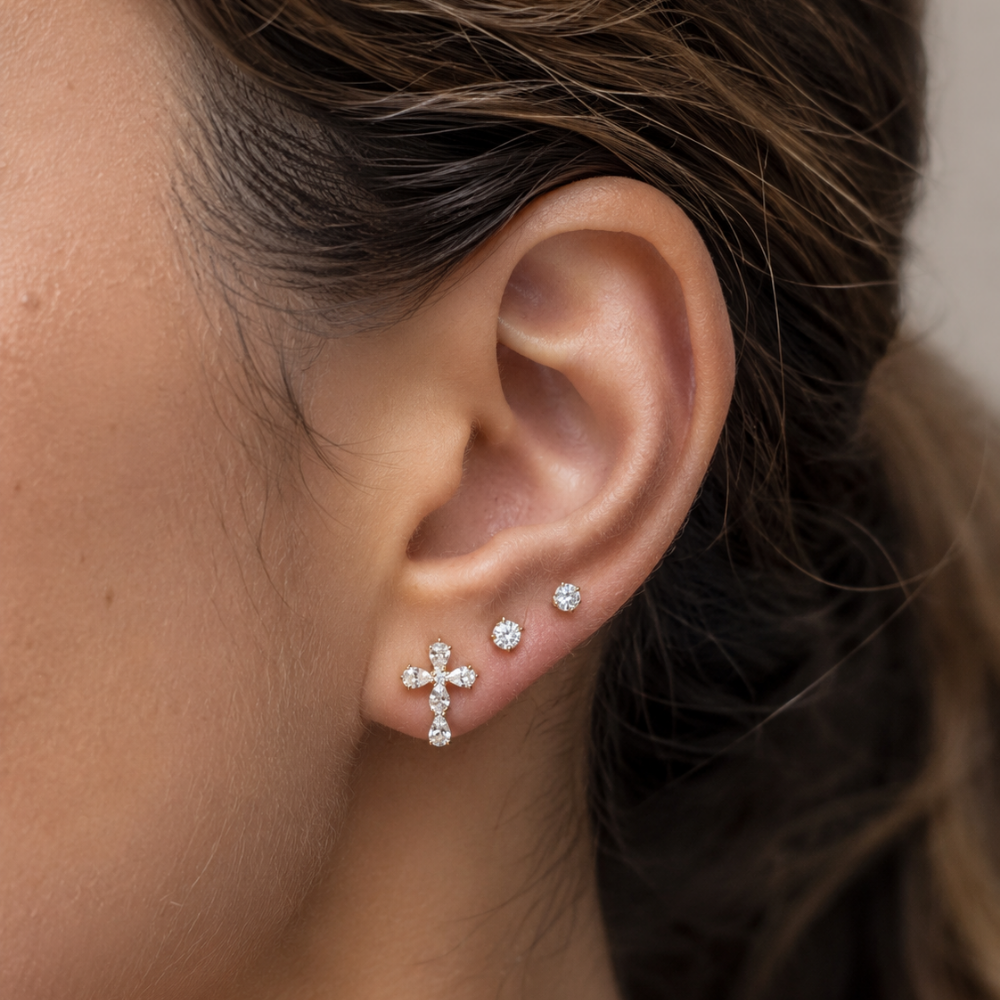
Successive lobe piercings arranged one above the other, popular in ear stack compositions. Pain and healing identical to those with a single flap. The only difference is the distance between piercings.

Transverse lobe
A horizontal piercing passing through the flap, with two visible ends of the barbell on one surface of the skin. A rarer variant, it requires more tissue than the standard flap.

Helix
The upper edge of the ear cartilage - one of the most frequently chosen cartilage piercings, great for combining into compositions.

Forward helix
The front part of the cartilage, closer to the face. A less known helix variant, increasingly chosen in ear treatment compositions. A small amount of tissue in this place requires precise selection of the size of the jewelry.

Tragus
A small, stiff projection of cartilage at the entrance to the ear canal. The procedure requires an experienced piercer.

Anti-tragus
A fold of cartilage opposite the tragus, above the lobule. One of the most anatomically difficult ear piercings, because not every ear has enough tissue in this place.

Rook
A fold of cartilage just above the tragus. One of the more painful ear piercings due to the small amount of tissue and the need to pass through the fold at an angle.

Daith
The inner fold of cartilage, just above the entrance to the ear canal. This is one of the few cartilage piercings where you can consider a delicate segment clicker instead of a horseshoe piercing at the beginning, provided that the size is selected by the piercer.

Conch
The middle, largest part of the auricle. variant inner (close to the center of the ear) or outer (on the outer edge). The large tissue surface allows for a wide selection of jewelry after healing.

Snug
The inner fold of cartilage above the contratragus. One of the most anatomically difficult and longest-to-heal ear piercings.

Orbital
Two piercing points (e.g. helix + helix or tragus + helix) connected by one ring, creating a visual effect similar to industrial, but with a ring instead of a simple barbell. Both points heal partially independently.

Industrial
Two cartilage piercings (usually helix + forward helix or two helix points) connected with one straight barbell passing through both holes. Demanding ear piercing, two points heal at the same time, despite sharing jewelry.


