


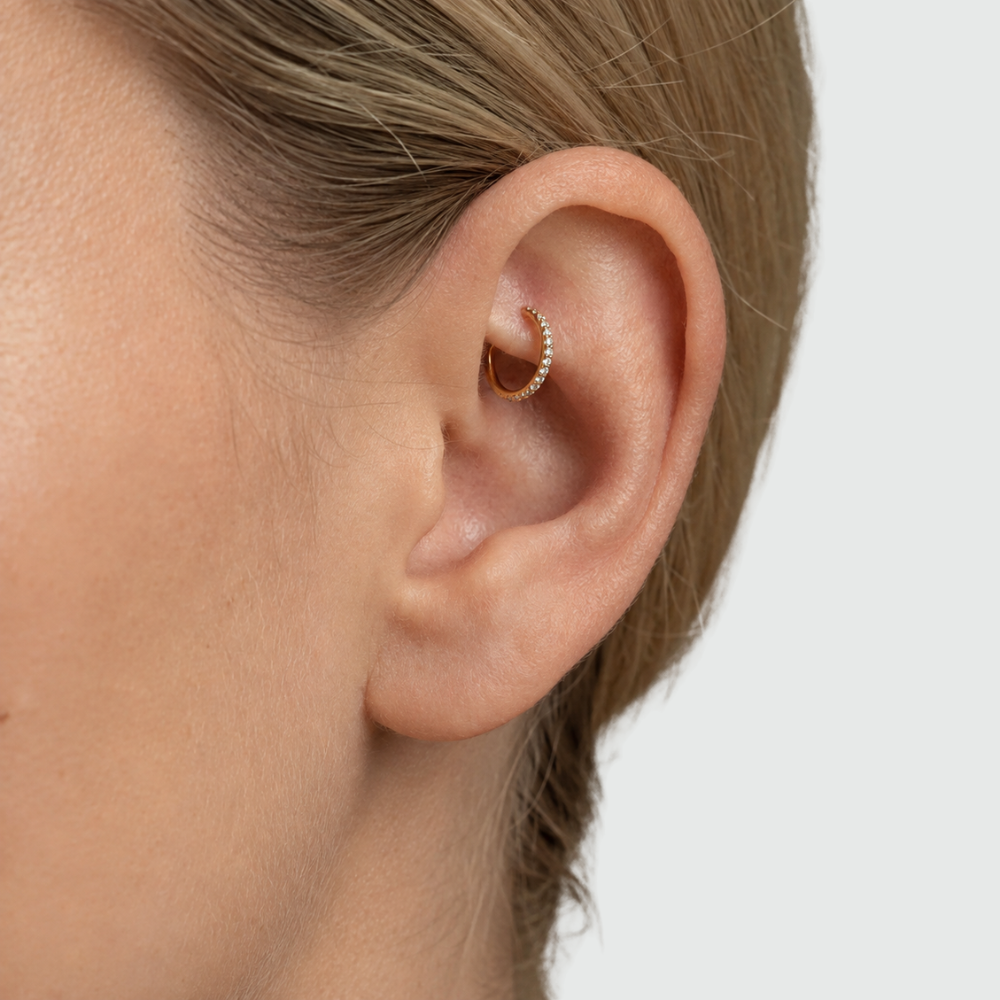
Rook Piercing
Rook, i.e. piercing the lower branch of the ear, is one of the most intriguing and desirable types of cartilage piercing. Located deep in the ear shell, above the ear canal and Daith piercing, it creates a unique, "hidden" effect that blends beautifully with any other jewelry.
Its positioning makes it relatively safe from accidental snagging, but it requires precise anatomy and patience while it heals. W Piercing Planet We have prepared for you a compendium of knowledge about this unique piercing.
What is Rook Piercing?
The rook passes vertically through a thick fold of cartilage (the so-called lower limb of the dike).
Key issue - anatomy: This piercing is highly dependent on the structure of your ear. In order for them to be made, the fold of cartilage must be properly developed, protruding and deep enough to safely accommodate the jewelry. If your rook is very flat or shallow, an experienced piercer will advise against getting a Rook and will suggest a safer alternative (e.g. Flat or Faux Rook).
Does a Rook piercing hurt?
As with Anti-Tragus, we are piercing one of the thickest and hardest cartilage structures in the ear.
Pain is most often assessed as: 5 to 6 on a 10-point scale. The sting itself is usually accompanied by a strong feeling of pressure (so-called "pressure") and a characteristic "crunch", which is loud due to the proximity of the ear canal. After the procedure, the ear may be very tender and pulsate strongly for several to several days.
Healing time and Rook care
Rook takes a long time to heal, but it has one huge advantage - it "hides" inside the auricle, making it much less susceptible to being caught by hair, a brush or clothes than the classic Helix.
- The initial stage of healing (swelling goes down): 3 to 5 months.
- Complete healing of the canal: from 6 to 12 months.
How to care for a fresh piercing? (Principles of care)
- Don't touch: Avoid touching the earring with dirty hands and refrain from "spinning" it.
- Cleanse regularly: Wash the piercing site 2-3 times a day with sterile saline solution.
- Avoid chemicals: Avoid using hydrogen peroxide, alcohol or antibiotic ointment. They may irritate the wound and delay healing.
- Be careful with your hair and clothes: Make sure that shampoo or conditioner does not remain on the ear after bathing. Be careful when putting on sweaters!
What jewelry for Rook piercing?
The shape of the cartilage fold and the vertical piercing channel require the use of specific types of jewelry.
During healing:
The gold and only safe standard to start with is curved barbell, i.e. Banana (Curved Barbell), made of hypoallergenic material titanium G23. Its curvature fits perfectly into the natural arch of the cartilage, minimizing tension.
- Rod Thickness: 1.2mm.
- Starting Length: Typically 8mm or 10mm. Due to the large thickness of the tissue, Rook can swell dramatically a few days after the procedure (so-called delayed swelling), so a long rod is necessary.
Downsize: Absolutely mandatory! When the swelling subsides (after about 4-8 weeks), the banana will start to protrude unsightly and move in the canal. You should go to the studio to replace the barbell with a shorter one that fits perfectly (often 6 mm).
After healing:
Once your Rook is fully healed, you can start playing around with the style:
- Small, fitted circles (Clickers) or the so-called seam rings.
- Decorative bananas with crystals on both ends.
- Subtle, geometric caps instead of the lower ball.
Decorative jewelry for Rook Piercing


- Titanium
- Clicker
Titanium Segmented Clicker With Cubic Zirconias Rim - Circle
Choose your option


- Titanium
- Internal Thread
Titanium Banana with Balls - Internally Threaded
Choose your option


- Titanium
- Clicker
Titanium Segmented Clicker with Cubic Zirconia Pendant – Ring
Choose your option


- Titanium
- Internal Thread
Titanium Decorative Banana - Balls with Cubic Zirconias
Choose your option


- Titanium
- Internal Thread
Titanium Decorative Banana - Zircons
Choose your option


- Titanium
- Clicker
Titanium Segmented Clicker - Double Ring with Cubic Zirconia
Choose your option


- Titanium
- Clicker
Titanium Triple Segment Clicker - Circle

Choose your option
Rook Piercing - Questions and Stories
Can I wear earphones with a Rook piercing?
Can I wear earphones with a Rook piercing?
Yes! Unlike piercings such as Tragus or Daith, the Rook is located in the upper part of the ear shell (on the crest of the ear), not blocking the entrance to the ear canal. For most people, this does not prevent them from wearing standard earphones or in-ear headphones, even during the initial healing period.
Can I put the wheel on Rook right away?
Can I put the wheel on Rook right away?
It is not recommended to put a ring on a fresh Rook piercing. The ring in the vertical canal of thick cartilage will be subjected to constant movement and pressure (especially when moving the ear or during sleep), leading to severe swelling, infection and the appearance of granulation tissue. The ring (clicker) can be safely placed only after the canal has completely healed (6-12 months).
How is Rook different from Daith?
How is Rook different from Daith?
Both piercings are located inside the ear, but on different folds of cartilage. Rook passes through the upper, vertical edge of the ear (lower branch of the dike), aiming from top to bottom. The daith is located lower, at the very entrance to the ear canal (branch of the labrum) and is pierced horizontally. Additionally, healed Daith is perfect for large circles, while Rook looks great with banana or small circles.
Can I sleep on an ear with a rook piercing?
Can I sleep on an ear with a rook piercing?
No, sleeping on a freshly pierced ear is strictly prohibited. The pressure of the head on the pillow causes blockage of blood supply, pain and may lead to distortion (migration) of the piercing angle. A good solution to facilitate sleep is to use a croissant-type travel pillow - by placing your ear in the empty hole, you eliminate any pressure.


