


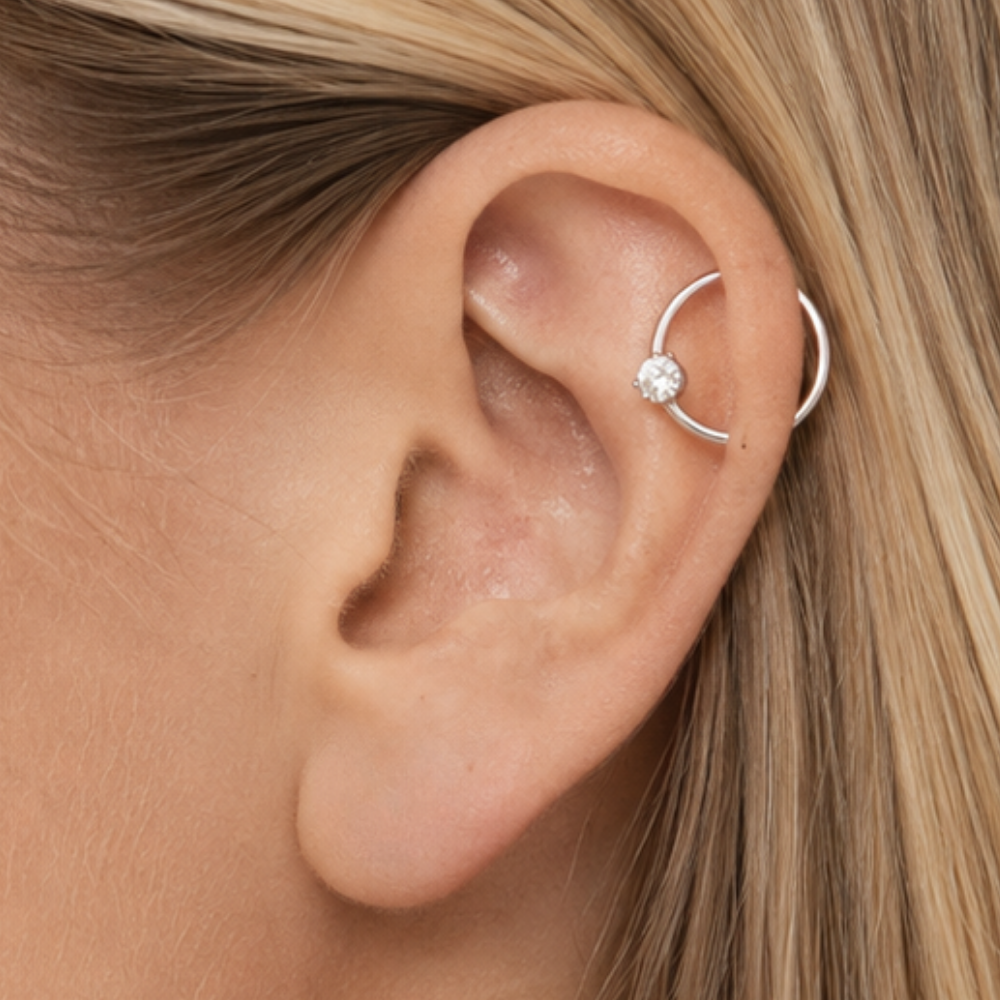
Orbital Piercing
Orbital this is an absolutely unique concept in the world of ear styling. Technically, it is not the name of a specific place on the ear, but a way to connect two separate piercings with one piece of jewelry (usually circles).
Effect? A phenomenal "orbit" that surrounds a part of the ear, attracting attention with its unusual geometry. Building the perfect Orbital requires precise planning and appropriate anatomy, but the end result is worth it. W Piercing Planet We've prepared everything you need to know about this fascinating system.
What is Orbital Piercing?
The biggest myth about this piercing is that it is confused with putting a ring in a regular Concha or Helix.
Remember: The classic ring on the edge of the ear (e.g. in Conch) goes through ONE hole. An orbital ALWAYS passes through TWO holes at a time.
The most popular locations for Orbital are:
- Lobe Orbital: Two piercings on the soft earlobe connected by a small circle. The fastest in healing and very effective.
- Helix Orbital: A ring connecting two piercings on the upper edge of the cartilage (somewhat reminiscent of the Industrial arrangement, but connected by a ring instead of a straight barbell).
- Conch Orbital: One piercing inside the ear shell (Conch) connected to the other at the edge.
Does Orbital piercing hurt?
Since Orbital is actually two separate piercings, the pain depends directly on the selected area.
- In case earlobe (Lobe) pain is negligible (1-2/10).
- In case cartilage (Helix, Conch) the sensations are stronger and usually amount to 4 to 6 on a 10-point scale.
The procedure requires incredible precision from the piercer (the so-called mapping). The distance between the two dots must be matched to the diameter of the target ring to the nearest millimeter, so that in the future the jewelry neither "hangs" loosely nor painfully stretches the tissue.
Lobe healing time and care
Earlobe healing is a relatively short and hassle-free process as long as you follow basic hygiene rules.
- Initial healing time: 6 to 8 weeks.
- Complete healing of the canal: up to 3 months.
How to care for a fresh piercing? (Principles of care)
Orbital healing in cartilage is considered very demanding because two wounds are connected with one moving element. This causes tension which the tissue cannot tolerate.
- The initial stage of healing (swelling goes down): from 2 to 5 months (depending on the location).
- Complete healing: up to 3 months for Lobe, from 6 to 12 months for cartilage.
How to heal this area safely?
- Labret method (Recommended!): The safest and fastest way is to make two piercings and insert two separate, straight labrets into them while they heal. When the canals heal completely (after a few or a dozen months), the piercer removes the labrets and fastens them with a dream ring.
- Starting circle method: It is possible to put the ring on immediately during the procedure, but it drastically prolongs the healing process and drastically increases the risk of granulation tissue (so-called blisters) formation.
- Zero pressure at night: Whichever method you choose, locking head pressure into the connected channels is critical to success.
Save your piercing from granulation tissue at night!
The tension between connected piercings is still a big challenge for the body - don't put pressure on it while you sleep!
W Piercing Planet we designed from scratch donut-shaped piercing pillows. The ear rests completely safely in the empty space.
Check out donut-shaped pillows!
What jewelry for Orbital?
The safety of materials in the case of such complex tension around ducts is an absolute priority.
Starting and Target Jewelry:
- If you are healing on separate labrets: You choose two classic titanium labrets with a flat disc (usually 1.2 mm thick and a length that takes into account swelling).
- Target circle (after healing): Smooth rings fastened with a segment (so-called Seamless Ring or Clicker) or, less frequently, rings closed with a ball (CBR) are used. The diameter (usually 8 mm, 10 mm, 12 mm or more) must be precisely measured by the piercer to perfectly connect both channels without stretching the tissue.
Titanium Quality Guarantee
Don't take our word for the composition of jewelry. At Piercing Planet, we care about your health - our titanium elements (both labrets and target rings) are made of Grade 23 titanium and have independent laboratory certificates confirming the lack of nickel and harmful admixtures.
Decorative jewelry for Orbital Piercing


- Titanium
- Clicker
Titanium Segmented Clicker With Cubic Zirconias Rim - Circle
Choose your option


- 316L steel
- Clicker
Steel Segment Clicker With Zircons - Circle
Choose your option


- Titanium
- Clicker
Titanium Double Segment Clicker with Cubic Zirconia - Ring
Choose your option


- Titanium
- Clicker
Titanium Segmented Clicker with Cubic Zirconia Pendant – Ring
Choose your option


- Titanium
- Clicker
Titanium Segmented Clicker Thick - Circle
Choose your option


- Titanium
- Clicker
Titanium Segment Clicker - Double Rim with Cubic Zirconia

Choose your option

- 316L steel
- Clicker
Steel Segment Clicker - Circle
Choose your option
Orbital Piercing - Questions and Stories
Can I make an Orbital using my old piercing?
Can I make an Orbital using my old piercing?
Yes, this is a very common practice! If, for example, you already have a healed earlobe (Lobe) or Helix piercing, the piercer can measure the distance from it and create a second, new piercing next to it, which will be connected to the old canal with a ring in the future (or immediately, if the anatomy allows it).
Why does my Orbital hurt and have blisters forming around it?
Why does my Orbital hurt and have blisters forming around it?
If you wear a ring with Orbital, the most common cause of granulation tissue (bubbles) and pain is poor adjustment of the diameter of the jewelry to the distance between the canals. A wheel that is too tight pulls the tissue towards itself, and a wheel that is too loose hits the cartilage with every movement of the head. Tension prevents the wound from healing properly. In such a situation, you should go to the studio and split the Orbital into two separate labrets.
Is the wheel in Conch Orbital?
Is the wheel in Conch Orbital?
NO. Although visually the wide ring attached to the Conch piercing wraps around the edge of the ear in an impressive way, it is not technically an Orbital. A conch piercing consists of one channel (one hole). An orbital, by definition, is one circle passing through two separate piercing channels.
I have a lump near my earring - what is it?
I have a lump near my earring - what is it?
A small "lump" is most often granulation tissue, which is caused by mechanical irritation (e.g. sleeping on the ear, getting caught in clothes) or a wrong angle of the piercing. Don't squeeze it! Consult your piercer and follow appropriate saline care.


