


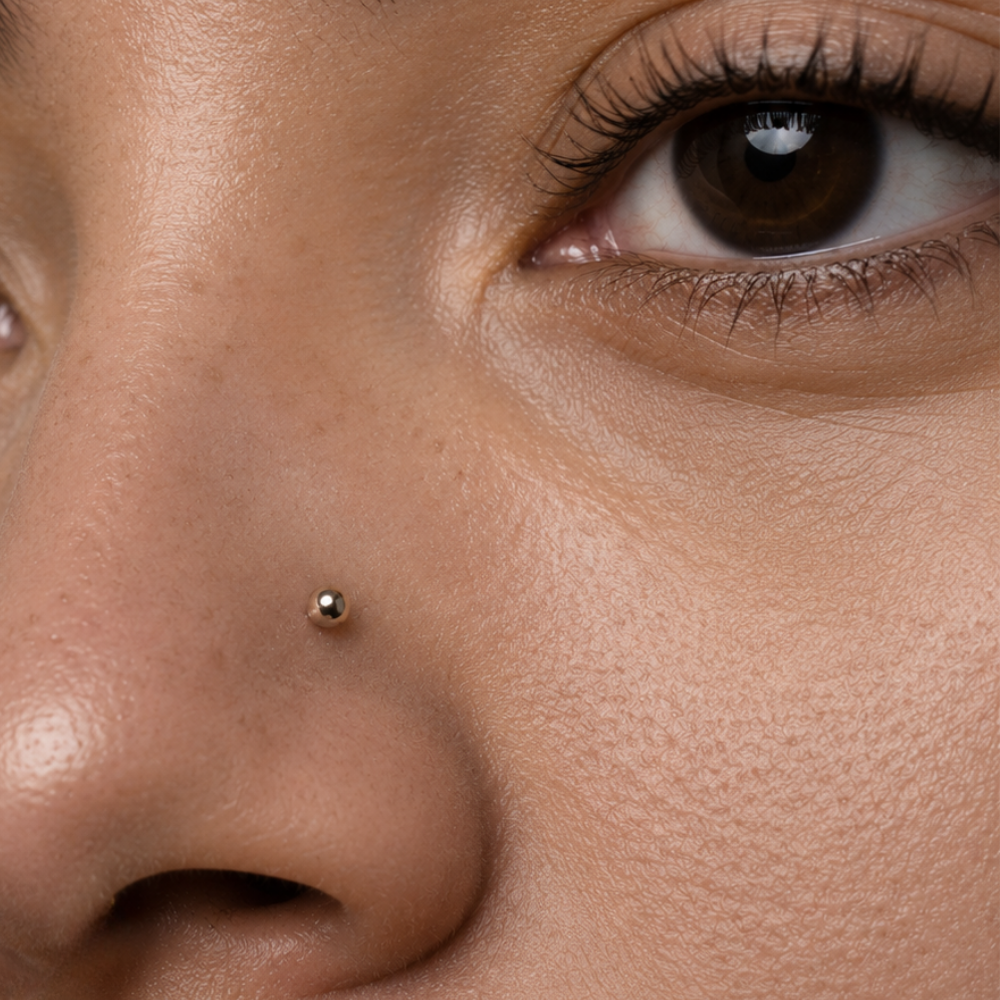
Nostril Piercing
Nostril, i.e. noselobe piercing, is undoubtedly the most popular facial piercing in the world. A subtle sparkling crystal on the side of the nose or a perfectly matched ring add character, emphasize facial features and suit literally everyone, regardless of style.
Although this is a very common piercing, the nose flap is still cartilage tissue that requires proper treatment, caution when going to the toilet in the morning and patience. W Piercing Planet we have prepared a complete guide for you, thanks to which your Nostril will heal without problems.
What is Nostril Piercing?
Nostril is performed on the wing of the nose. This location is not as strictly determined by anatomy as some ear piercings, which means that the piercer has a lot of freedom in choosing the ideal location.
In addition to the classic piercing, its variations are extremely popular:
- High Nostril: The piercing is located much higher on the nose lobe, closer to the bone. (Note: it heals harder and longer!).
- Double Nostril: Two piercings on the same side of the nose, placed next to each other (two adjacent rings are often worn).
- Paired Nostrils: Symmetrical piercings on both nose lobes.
Does a Nostril piercing hurt? And why will there be tears?
The nasal lobe is made up of thin but flexible cartilage. Pain during the procedure is an individual matter, but most often it is assessed as mild or moderate - approx 3 to 4 on a 10-point scale.
However, the procedure is almost always accompanied by one specific phenomenon: involuntary tearing. When the needle passes through the nasal cartilage, it irritates the trigeminal nerve, which causes an automatic tearing reflex of the eye on the side of the piercing. This is pure biology, not crying in pain - there is nothing to be ashamed of!
Nostril healing time and care
Even though Nostril heals faster than thick ear cartilage, this place is extremely vulnerable to contamination and mechanical injuries.
- The initial stage of healing (swelling goes down): from 2 to 4 months.
- Complete healing of the canal: from 4 to 6 months.
The most important rules of Nostril care:
- Be careful with towels and clothes: Getting a fresh nose ring caught in a towel loop is one of the most painful experiences. Use only disposable paper towels to dry your face!
- Makeup and cosmetics: During the first months, absolutely avoid applying foundation, powder, creams and acids in the piercing area. Cosmetics quickly clog the wound canal and lead to infection.
- Blowing your nose: Do it very gently, taking care not to stretch the wing of your nose. If you have hay fever or allergies, schedule your piercing outside of pollen season.
How to care for a fresh piercing? (Principles of care)
- Don't touch: Avoid touching the earring with dirty hands and refrain from "spinning" it.
- Cleanse regularly: Wash the piercing site 2-3 times a day with sterile saline solution.
- Avoid chemicals: Avoid using hydrogen peroxide, alcohol or antibiotic ointment. They may irritate the wound and delay healing.
- Be careful with your hair and clothes: Make sure that shampoo or conditioner does not remain on the ear after bathing. Be careful when putting on sweaters!
What jewelry to wear with Nostril?
The selection of starter jewelry is the foundation of success. Many people associate nose piercings with traditional Nostril screws or L-shaped earrings. Modern piercings are moving away from them in favor of a much safer solution.
During healing:
Currently, the gold standard is application a simple Labret (preferably with a flat disc on the back) made of Titanium G23.
- Why Labret? It does not fall out while sleeping or washing the face, it does not rotate in the piercing canal and does not irritate the mucous membrane inside the nose.
- Rod Thickness: Most often 1.0 mm or 1.2 mm.
- Length: To start with, you'll need a longer rod (e.g. 7mm - 8mm) to accommodate the swelling.
Downsize: A necessity! When the nose stops being swollen, the earring will start to stick out unsightly. Go to the studio to exchange it for a shorter labret (usually 6 mm) to avoid it snagging.
Decorative jewelry for Nostril Piercing


- Titanium
- Internal Thread
Titanium Labret with Ball - with Internal Thread
Choose your option


- Titanium
- Internal Thread
Titanium Decorative Labret - Diamond


Choose your option


- Titanium
- Internal Thread
Titanium Decorative Labret - Flat Cubic Zirconia
Choose your option


- Titanium
- Clicker
Titanium Segment Clicker with Cubic Zirconias Rim - Circle
Choose your option


- Titanium
- External Thread
Titanium Labret with Ball - with External Thread

Choose your option


- 316L steel
- Clicker
Steel Segment Clicker with Zircons - Circle
Choose your option


- Titanium
- Internal Thread
Titanium Decorative Labret - Three Zircons


Choose your option
Nostril Piercing - Questions and Stories
Can I put the ring on a fresh Nostril right away?
Can I put the ring on a fresh Nostril right away?
NO. Although many people dream of a hoop, putting it on a fresh piercing is a huge mistake. The wheel is movable, introduces bacteria into the wound and presses the canal with its curves. In 9 out of 10 cases it ends with the so-called granulation tissue (a painful, raised lump next to the piercing) and prolonged healing up to several months. The ring can be safely placed only after complete healing and the formation of the canal (minimum 4-6 months).
I have a red lump near my nose ring - what is it and what should I do?
I have a red lump near my nose ring - what is it and what should I do?
This is granulation tissue (hypertrophic scar). It occurs due to irritation - getting caught in a towel, using aggressive make-up removal cosmetics, inserting the ring too early or sleeping on this side of the face. Do not pierce it under any circumstances, do not use hydrogen peroxide, alcohol or toothpaste! Start gently rinsing your nose with saline, use paper towels, and if you are wearing an earring that is too long, go to a piercer to have it shortened (downsize).
Is there a large scar left after removing a nose ring?
Is there a large scar left after removing a nose ring?
The nose flap regenerates very well. If the piercing was healed properly and performed by a professional, when the piercing is removed permanently, most often only a microscopic mark remains, which closely resembles a slightly enlarged skin pore or a small acne scar. Just a bit of foundation is enough to make it completely invisible.


