


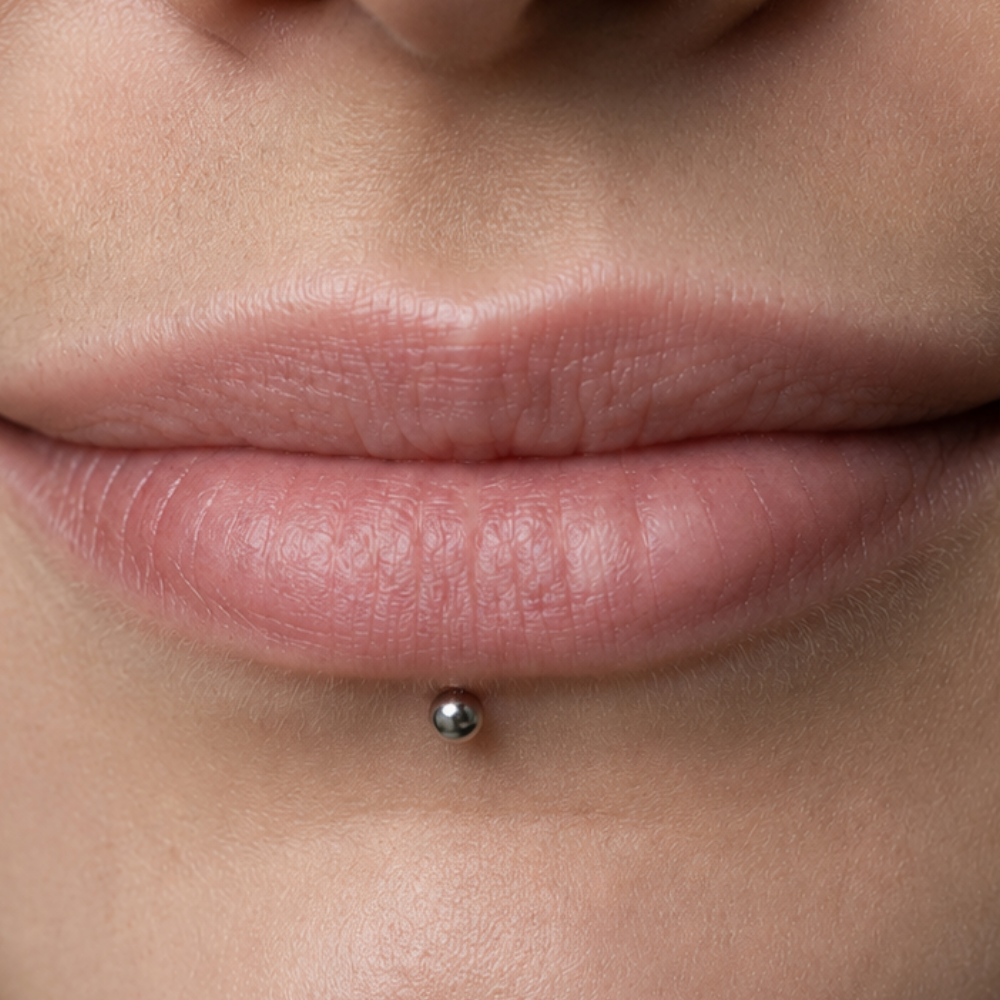
Labret Piercing
Labret this is the absolute foundation when it comes to lip and mouth piercing. This word has a double meaning in the world of piercing - it describes both the type of jewelry itself (an earring with a flat disc on the back) and central piercing located just below the lower lip.
This is an extremely universal piercing that looks great with a minimalist ball, a flat disc, and after healing - with a matching ring wrapping around the lip. W Piercing Planet We have prepared a complete guide for you that will take you step by step through the healing process, with particular emphasis on the safety of your teeth and gums.
What is Labret Piercing?
The classic Labret pierces the tissue under the lower lip through and through - from the outside of the skin to the inside of the mouth (mucous membrane). It is worth remembering that a whole lot of iconic patterns were created on the basis of this one piercing (so-called bites):
- Side Labret: The piercing is made asymmetrically, on the side of the lower lip.
- Snake Bites: Two symmetrical Side Labrets on either side of the lip, resembling a snake bite.
- Spider Bites / Viper Bites: Two piercings placed close to each other on one side of the lip.
- (Tip: If the piercing goes vertically through the red lip itself, without entering the mouth, it is a Vertical Labret - it is a completely different piercing!)
Does a Labret piercing hurt?
The tissue around the mouth is soft, but densely supplied with blood and innervation. Piercing it with a sterile needle is usually described as a quick, sharp pinch.
Pain is moderate and most often rated at 3 to 4 on a 10-point scale. The biggest challenge with this piercing, however, is not the procedure itself, but what happens a few hours later:
- Massive swelling: The lip reacts very violently to interference. Be prepared for the fact that during the first few days your lower lip may be enlarged two or even three times! For this reason, the piercer will initially put on an unnaturally long earring.
Labret healing time and care
A labret is a specific piercing because it heals in two extremely different environments: from the outside on the dry facial skin, and from the inside in the constantly moist oral mucosa.
- The initial stage of healing (swelling goes down): from 2 to 4 weeks.
- Complete healing of the canal: from 2 to 4 months.
How to care for a fresh piercing? (Principles of care)
- Don't touch: Avoid touching the earring with dirty hands and refrain from "spinning" it.
- Cleanse regularly: Wash the piercing site 2-3 times a day with sterile saline solution.
- Avoid chemicals: Avoid using hydrogen peroxide, alcohol or antibiotic ointment. They may irritate the wound and delay healing.
- Be careful with your hair and clothes: Make sure that shampoo or conditioner does not remain on the ear after bathing. Be careful when putting on sweaters!
What jewelry for Labret piercing?
Choosing the right material and size is a priority when it comes to oral piercings. A poorly selected earring may permanently damage the enamel and gums. We care about educating our clients, which is why we do not compromise.
During healing:
Piercer uses Labret with a flat disc on the back.
- Safe Titanium: The moist oral environment is a test for jewelry. We use and recommend exclusively Surgical Titanium (G23). It does not cause allergies, does not rust and does not release nickel into the body, which is crucial for quick healing of the mucosa.
- Rod Thickness: Most often 1.2 mm.
- Starting Length: Even 10 mm or 12 mm, depending on the size of the natural swelling (the disc at the back cannot penetrate the enlarged lip!).
Downsize (Shortening the bar) – YOUR RESPONSIBILITY!
When the swelling subsides after about 3-4 weeks, a long rod will begin to fly in the mouth. It will hit your teeth when you talk and bump against your gums. Ignoring downsize is the shortest path to slipping gums (recession) and chipping of teeth. You absolutely need to go to a piercer to replace the rod with a short one that perfectly fits your lip (usually 6 mm or 8 mm).
Labret Piercing - Questions and Stories
Does lip piercing (Labret) damage teeth and gums?
Does lip piercing (Labret) damage teeth and gums?
Lip piercings pose this risk, but it can be almost completely reduced! Enamel damage and gum recession result in 99% of cases from wearing a bar that is too long after healing or constantly "playing" with the earring (biting it, sliding it over the teeth). If you properly downsize (replace the jewelry with a perfectly fitting one) and the earring has been made at the correct angle by a professional, the risk of damaging your teeth is reduced to a minimum. After healing, some people also choose jewelry made of bioplastic (PTFE), which is softer to the enamel, but Tytan G23 remains the most sterile and durable choice.
Why does the skin on the inside of the lip "overgrow" the piercing?
Why does the skin on the inside of the lip "overgrow" the piercing?
This is a natural phenomenon called "nesting". The flat disc of the labret naturally blends slightly into the soft mucosa on the inside of the mouth, creating a small depression. Thanks to this, the disk becomes even with the surface of the lip and does not hit the teeth. Note: "Nesting" is completely different from "embedding". If the mucosa swells so much that it begins to completely cover the disc at the back and it causes pain, contact your piercer immediately - you need a longer rod!
What can I eat after getting a lip piercing?
What can I eat after getting a lip piercing?
For the first 7 to 14 days after the procedure, your diet will require minor modifications. Due to swelling and a very long starter earring, it is recommended to eat cool, soft foods (yogurts, smoothies, purees, cream soups). Absolutely avoid hot, very spicy, sour and very salty foods, which will immediately "burn" a fresh wound in the mouth. Also, be careful with foods that require intense chewing (e.g. hard meat, chewing gum) so as not to catch your teeth on a metal bar!
Can I use anesthesia or soothing ointment for fresh Labret?
Can I use anesthesia or soothing ointment for fresh Labret?
There is usually no reason to worry. During the first weeks, lymph (blood plasma) naturally oozes from the wound. It is a whitish or slightly yellow, odorless liquid that dries around the piercing, forming hard scabs (so-called "crusties"). This is a sign that the body is properly building a new skin channel! Infection is indicated only by the appearance of thick, greenish pus with a very unpleasant odor, accompanied by throbbing pain, redness, fever and severe swelling. If in doubt, always consult your piercer.


